French Mayor Proposes Criminalizing ‘Great Replacement’ Debate
A French mayor suggests criminalizing discussions on the ‘Great Replacement’ theory, sparking political and social debate in France.
5 min read
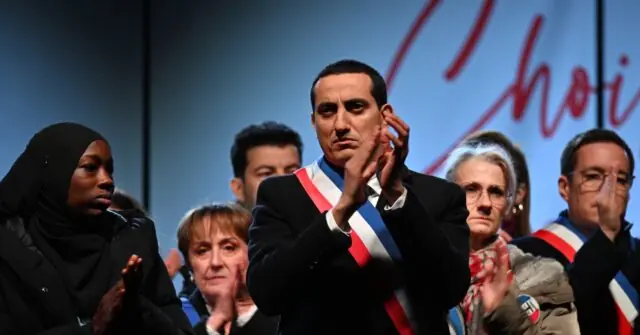
French Mayor Ali Rabeh, a prominent leftist figure from the multicultural suburb of Trappes, has proposed criminalizing public discussions on the so-called ‘Great Replacement’ theory, a concept that has sparked intense debate across political and social spheres in France. Rabeh, who is of Moroccan heritage, has called on the government to amend the 1881 law on press freedom to include penalties for those who promote the idea that non-European populations are replacing native French citizens. According to Rabeh, this theory has been used to justify the recent shooting in his city, where an individual killed one and injured five others in an alleged act of retaliation against ethnic and religious minorities.
The ‘Great Replacement’ Theory and Its Origins
The term ‘Great Replacement’ was first coined by French philosopher Renaud Camus, who argued that Western elites view their citizens as interchangeable economic units that could be replaced by cheaper migrant labor with little consequence. Rabeh has pointed to the influence of this theory in shaping the political discourse, particularly in relation to the recent shooting incident in Trappes. He claims that the so-called ‘far-right’ has been responsible for the attack, which he attributes to the radicalization of the suspected shooter, who he believes was influenced by discussions surrounding the ‘Great Replacement’ concept.
Political Reactions and Criticisms
Rabeh’s comments have drawn strong reactions from various political figures. Presidential candidate Éric Zemmour, a leading proponent of re-migration in France, responded by calling the proposal a ‘Gulag on the march’ and referring to the ‘project of their socialist-Islamic Republic.’ Zemmour, who has been convicted for inciting racial hatred, has been invited to numerous talk shows despite his legal troubles, a fact that Rabeh has criticized as being inconsistent with the proposed law.
Other political figures have also expressed concerns about the potential consequences of Rabeh’s proposal. Jordan Bardella, the leader of the National Rally and the current favorite to become France’s next prime minister, has warned that the move would ‘criminalise the feelings of at least 60 per cent of the French,’ who observe a ‘profound demographic transformation.’ Bardella’s remarks highlight the broader societal implications of the debate, suggesting that a significant portion of the French population supports the idea of demographic change, even if they do not necessarily endorse the ‘Great Replacement’ theory.
Public Sentiment and Demographic Projections
A survey conducted by the Institut français d’opinion publique (Ifop) earlier this year found that six in ten French people believe that the French are being ‘progressively replaced by non-European populations, primarily from the African continent.’ Among those who agreed with this sentiment, 66 per cent said it was entirely bad, compared with 21 per cent who were neutral, and nine per cent who thought it was a good thing. These findings underscore the deep divisions within French society regarding the issue of immigration and demographic change.
Further supporting the notion of a significant demographic shift, a report from the Immigration and Demography Observatory (OID) in Paris forecasts that if immigration levels continue at their current pace, the native French population — defined as those whose grandparents were born in the country — are set to become a minority in their own country by around 2050. The report also predicts that people of non-European extraction will become the majority by the mid-2070s. These projections highlight the urgency of the debate, as they suggest a fundamental transformation in the demographic composition of France over the coming decades.
Far-Left Support for the ‘Great Replacement’ Concept
Interestingly, the ‘Great Replacement’ theory has also found support among some far-left political figures in France. Presidential candidate and leader of the far-left France Insoumise party (France in Rebellion/LFI), Jean-Luc Mélenchon, has hailed the concept and the formation of a ‘New France.’ Mélenchon, who often criticizes ‘ugly’ white France, has previously admitted that the hard left cannot rely on the rural, white working class to support socialism. This suggests that the ‘Great Replacement’ theory is not solely a far-right narrative but has also been embraced by certain elements of the far-left, who see it as a means to reshape French society.
Other members of the France Insoumise party have also embraced the concept, including MP Clémence Guetté, who boasted in June that efforts to preserve the native white population had failed. Guetté declared in the National Assembly: ‘You have lost the racist ideological battle. Today, one in three French people is already linked to immigration.’ These statements indicate that the ‘Great Replacement’ theory has become a central theme in the political discourse, with both left and right factions engaging with it in different ways.
Legal and Social Implications
Rabeh’s proposal to criminalize discussions on the ‘Great Replacement’ theory has significant legal and social implications. The amendment to the 1881 law on press freedom would not only affect public discourse but also potentially criminalize a large portion of the French population. Rabeh argues that the current provisions preventing incitement to racial hatred are ‘insufficient,’ suggesting that the law needs to be ‘toughened’ to address the perceived threat of the ‘Great Replacement’ narrative.
However, critics of the proposal argue that it could lead to the suppression of free speech and the marginalization of those who hold the view that France is undergoing a demographic transformation. The debate over the ‘Great Replacement’ theory thus reflects broader tensions in French society, where discussions about immigration, identity, and the future of the country are increasingly polarized.
Source: Breitbart