NASA’s Swift Observatory Set to Reenter Earth After 21 Years in Orbit
NASA’s Swift Observatory, launched in 2004, is expected to reenter Earth’s atmosphere today after 21 years of studying cosmic explosions.
2 min read
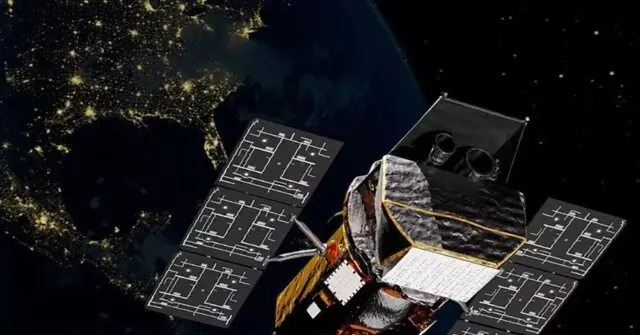
NASA’s Swift Observatory, a gamma-ray-hunting telescope that spent two decades observing the universe’s most violent explosions, is set to reenter Earth’s atmosphere today after 21 years in orbit. The spacecraft, weighing 3,200 pounds, is predicted to fall back to Earth mid-morning on Wednesday, according to NASA tracking data. The agency has mapped potential reentry paths across Central and South America, Africa, South and Southeast Asia, northern Australia, and portions of the Pacific, Atlantic, and Indian oceans. Any surviving fragments are expected to land within a broad equatorial band covering Latin America, Africa, southern Asia, and northern Australia. The United States and Europe are outside this zone.
End of a Long Mission
Launched in 2004 with a planned two-year mission, Swift far exceeded expectations, operating for 21 years. It was designed to detect gamma-ray bursts and other short-lived cosmic events, but its mission was cut short by increased solar activity, which caused its low Earth orbit to degrade faster than anticipated. “Re-entry locations of any surviving components can vary from hemisphere to hemisphere and depend on when it re-enters,” NASA noted in a statement.
Despite efforts to extend its lifespan, including a failed rescue mission in August, Swift continued to function until its orbit became too unstable for observations. NASA attempted to save the mission by sending a rescue spacecraft called Link, but the $30 million effort ended in failure after Link spun out of control shortly after launch. Although flight controllers managed to slow the tumbling, the craft never regained reliable pointing and positioning, and the rescue was abandoned.
Legacy of Scientific Discovery
Over its lifetime, Swift recorded more than 2,000 gamma-ray bursts and 1,400 exploding stars, along with comets, asteroids, and black holes devouring nearby stars. Its ability to quickly swing toward sudden cosmic eruptions allowed it to act as a first responder, alerting larger instruments like the Hubble and Webb telescopes to study these events in detail. Scientists are now working to fill the gap left by Swift’s absence in this early-warning role.
“Our fervent hope is that the lessons learned by the successes of Swift can be applied to new generations of space missions to accelerate our discoveries about the universe,” said John Nousek, a Pennsylvania State University astronomer who worked on the mission.
Source: Breitbart