Fort Hood Killer’s Past Raises Questions About Army Oversight
Questions remain about warnings and withheld information before Fort Hood killings, as Army psychiatrists face scrutiny.
2 min read
As former Army psychiatrist Nidal Hasan faces execution, questions remain about warnings dismissed before the Fort Hood killings and information withheld afterward. Nine Army officers faced disciplinary action, but their names and individual punishments were withheld from the public.
Senate Report Highlights Failures in Monitoring Radicalization
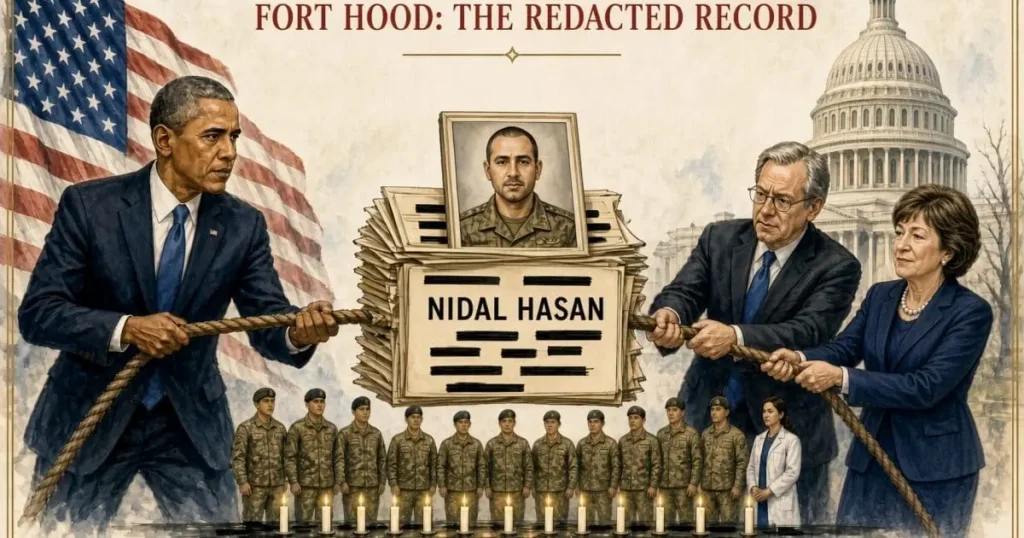
Senators Joseph Lieberman and Susan Collins concluded that the Defense Department and FBI had enough information to detect Hasan’s radicalization but failed to act. After three months of negotiations with President Obama’s executive branch, information remained withheld. Their objection appeared in a footnote of the 100-page report: “We take issue with the extent of these redactions, some of which we believe are unjustified, but we have consented to them in order to produce this report in a timely manner.” The statement appears in footnote 1 on printed page 8 of A Ticking Time Bomb, the Senate’s February 3, 2011, Fort Hood investigation report.
Hasan’s Presentation and Military Evaluations
Before killing 12 soldiers and a civilian physician assistant at Fort Hood, Army psychiatrist Hasan delivered a 50-slide presentation in 2007 to his supervisors and about 25 other mental health staff members at Walter Reed. Col. John Bradley headed Walter Reed’s psychiatry department. A military evaluation praised Hasan’s research on Islamic beliefs regarding military service as having “extraordinary potential to inform national policy and military strategy.” The Senate report described evaluations that “sanitized his obsession with violent Islamist extremism into praiseworthy research on counterterrorism.”
FBI’s Inaction and Oversight Concerns
Meanwhile, San Diego FBI investigators monitoring extremist cleric Anwar al-Awlaki flagged Hasan’s communications with him. According to the report, FBI personnel in Washington relied on favorable military evaluations and treated the contact as legitimate research. San Diego challenged the inquiry as “slim,” but the disagreement went unresolved. The FBI did not alert Hasan’s Army command before the killings.
Questions About Accountability and Redactions
Was the FBI’s Behavioral Analysis Unit consulted? What information did it receive, and what assessment did it provide? If it was not consulted, why not? The FBI used behavioral analysis experts to assess another terrorism suspect, Hosam Smadi, during the same period.
Supervisors’ Concerns and Public Scrutiny
The Associated Press reported that some of Hasan’s supervisors expressed serious concerns about his behavior, judgment, and competence, yet continued giving him positive evaluations. Nine officers faced reprimands ranging from oral warnings to written censure, but the Army withheld their names and individual punishments. The officers also had the right to appeal.
Source: The Gateway Pundit