Bolsonaro Seeks Election Annulment Over Alleged Judicial Bias
Brazilian senator Flavio Bolsonaro claims election irregularities invalidated Lula’s win, citing STF interference and alleged vote-buying.
5 min read
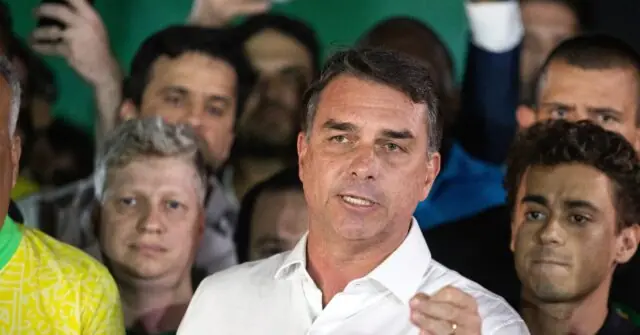
Conservative presidential candidate Sen. Flávio Bolsonaro has announced his intention to request the nation’s top electoral court to annul the results of Sunday’s presidential election, which declared incumbent socialist Luiz Inácio Lula da Silva the victor. Bolsonaro, who ran as the candidate for the Liberal Party, claims the election was marred by a series of abuses of power and judicial overreach, particularly by the Supreme Federal Tribunal (STF), which he argues violated Brazil’s election integrity.
Contested Election and Legal Challenges
Lula, who turns 81 on Tuesday, officially won a fourth term in office on Sunday after losing to Bolsonaro in the first round of the presidential vote in early October. Bolsonaro received 47 percent of the vote, falling below the 50-percent threshold necessary to avoid a runoff election. As a result, he and runner-up Lula were given another month to campaign for the October 25 election date.
While the final vote showed Lula winning with upwards of 4 million votes, a decisive margin in Brazilian politics, the Bolsonaro camp cited a variety of irregularities, most prominently the decision by a justice on the STF to keep polling stations open past the 5 p.m. deadline in response to a Lula demand to do so in the northeast of the country, citing transportation challenges for voters. The northeast is traditionally a socialist stronghold.
The STF does not have the authority to interfere in election rules; Brazil has a separate court, the Superior Electoral Tribunal (TSE), that handles election rules and integrity. Even if it did, Justice Cristiano Zanin, who issued the decree and had previously served as Lula’s defense attorney before being on the court, does not have the ability to override his peers and single-handedly issue such a rule-change. Multiple reports in Brazilian media claimed the other ten STF justices did not agree with the plan to extend the vote.
Bolsonaro’s Legal and Political Claims
Bolsonaro cited the unprecedented intervention by Zanin as the core of his call for the annulment of Lula’s victory, which the TSE certified despite the court breach. In a video published on social media on Monday, Bolsonaro stated, “I will ask, yes, the annulation of the Lula ticket for all the abuses he committed. The law has to apply to everyone. The competition has to be fair and equal, which did not happen.”
He also accused Lula of using public funds—up to half a trillion reais (about $93.5 billion)—to boost his election, calling it “the largest vote purchase in the history of elections in Brazil.” Bolsonaro further claimed that rumors of his planning to leave the country were false and reiterated his claim that Lula’s government had harassed him to surrender his passport. “I never thought to leave the country. I will hand over my passports and will defend myself from this aberration, which is a clear attempt to intimidate me. Nobody will silence me,” he asserted, adding that the demand to hand over the passport was political persecution.
“Think with me: if I had won the election, would the same thing happen? Flávio Bolsonaro is elected, would that federal police be intimidating me in the middle of the street anyway?” he asked. The plan to request the TSE to annul the election differs slightly from what Bolsonaro had first announced on Sunday night. He refused to accept the results then, as well, but stated that he would essentially pursue a re-do of the election.
“There was a complete breakdown of equality among Brazilians from different cities and states. I’ll never know how many votes I might have received in a state where the polls weren’t reopened. It’s inexplicable that what happened actually happened,” Bolsonaro said on Sunday. “It is impossible to recognize the result of the elections in the context. We will ask for the annulment.”
Political Response and Internal Party Dynamics
The Liberal Party, to which Bolsonaro belongs, recognized the results of the election on Monday, raising questions regarding whether Bolsonaro would continue to pursue action to investigate, or potentially overrule, the election results. The official party statement continued to cast doubt on the integrity of the election, however, asking for clarification into exactly how Justice Zanin was allowed to extend voting times.
“We recognize the presidential result, proclaimed by the Superior Electoral Tribunal, but we understand that the questions raised need to be appropriately clarified within an equalized and democratic political debate,” the statement read in part. The Brazilian newspaper O Globo reported on Monday that Bolsonaro had been consulting his top political allies to discuss the appropriate next steps for the right. Outside of the presidential election, conservatives obtained decisive wins in critical governorships nationwide and now control the Senate and Chamber of Deputies, the equivalent of the House of Representatives.
Impeachment may be an option, reports indicate, separate from questioning the election itself. Those discussions with allies, O Globo claimed, resulted in Bolsonaro being told not to flee the country but, rather, “preserve the political capital accumulated during the campaign and stay in touch with governors, lawmakers, and party leaders who will support his candidacy.”
Broader Implications for Brazil’s Political Landscape
Bolsonaro’s claims and the subsequent legal challenges have broader implications for Brazil’s political landscape. With the Liberal Party’s control of key legislative bodies, the potential for a political showdown looms large. If Bolsonaro’s legal actions gain traction, they could set a precedent for challenging election outcomes in the future, potentially reshaping the political dynamics of the country.
Additionally, the controversy surrounding the STF’s decision to extend voting hours has sparked a national debate on the role of the judiciary in electoral processes. Critics argue that such interventions could undermine public trust in the electoral system, while supporters of the STF maintain that it was a necessary measure to ensure voter access, particularly in regions with significant transportation challenges.
As the situation unfolds, the Brazilian public and international observers will be closely watching to see how the legal and political ramifications of this election dispute play out. The outcome could have significant implications for the future of Brazilian democracy and the balance of power between the executive, legislative, and judicial branches.
Source: Breitbart