Ohio Ad Controversy Sparks Debate Over Political Decency and the Referee Test
Ohio’s political ad feud tests the limits of political decency and raises questions about partisan double standards.
5 min read
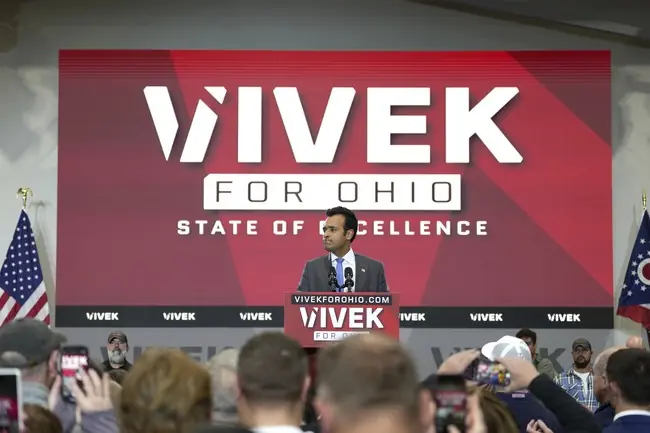
In the latest twist of Ohio’s political drama, Republican gubernatorial candidate Vivek Ramaswamy’s campaign has launched a $4 million ad featuring Donna Arthur, the estranged mother of Democratic nominee Amy Acton. The ad, which calls Acton dishonest and questions her account of childhood hardship, has drawn sharp criticism from Ohio Governor Mike DeWine, who has called it ‘wrong’ and urged its removal. President Donald Trump, however, has praised the ad, calling it ‘powerful’ and wanting it to remain on the air.
The ad, which portrays Arthur as a woman who disputes her daughter’s claims, has reignited a broader debate about the ethical boundaries of political advertising. DeWine, despite his objections, has not rescinded his endorsement of Ramaswamy, stating, ‘I’m not changing the endorsement. I endorse the whole ticket.’ This split within the Republican Party highlights the complexity of the issue, as it is not merely a partisan disagreement but a matter of political decency and consistency.
#OHPol: "My name is Donna Arthur, and I am Amy Acton's mother … I love my daughter, but when I saw her lying about her opponent, it's not easy for a mother to say this, but Amy has a serious problem. She is a liar." Vivek Ramaswamy and Rob McColley are up with this new #OHGov ad on broadcast TV this morning. Total Ohio governor general election ad spending: 🔴$129.6M 🔵$44.5M
DeWine’s criticism is rooted in the backstory of the ad. He pointed out that Arthur’s husband was indicted by a grand jury after hearing testimony and that the family’s circumstances were more complicated than the ad suggests. ‘When you know the rest of the story, when you know the back story, when you know that the husband of the mom was indicted by a grand jury after hearing testimony and that he took off along with the mother, and that the two children never saw the mother after that. When you know that it, just to me, makes it more serious. It makes it just more wrong,’ DeWine explained.
However, the ad’s context is not without its own controversies. Court records corroborate Acton’s account that her stepfather was indicted for raping her when she was 12, but he left the state before trial. Acton and her brother were removed from their mother’s custody, and their mother remained married to him. While these records support Acton’s account, they do not prove every detail of her childhood recollections, making it unreasonable to treat Arthur’s accusations as established fact.
Now, the debate turns to the ‘Referee Test,’ a concept introduced in the source material to evaluate political consistency and fairness. The test asks whether politicians, the media, and government institutions apply the same standards when the political parties and people involved change. It measures consistency, exposes selective outrage and double standards, and asks one simple question: Are the same rules applied regardless of which party is involved?
A History of Political Ads and Their Impact
The Referee Test is not a new concept. In 1964, Lyndon Johnson’s campaign showed a little girl picking daisies before a nuclear explosion filled the screen. Barry Goldwater was never named, but the suggestion was obvious: Elect the Republican and risk nuclear annihilation. The spot became an American campaign classic, not an unfamiliar breach of political manners.
Similarly, in 2011, the Agenda Project, a progressive group, produced an ad that alleged Republican Paul Ryan’s Medicare reforms would effectively destroy the program. The ad used an imagined death to sell a political warning. ‘People could oppose Ryan’s proposal without pretending Republicans planned to toss elderly Americans to their deaths,’ the source notes.
A year later, Priorities USA Action, a pro-Obama super PAC, aired a steelworker’s story linking Mitt Romney’s business record to the death of the steelworker’s wife from cancer. The plant closed in 2001, she died in 2006, and Romney was organizing the Salt Lake City Olympics when the plant shut down. ‘Whatever one thinks of Bain Capital, the ad’s insinuation outran its evidence,’ the source states.
Political Ads and Their Consequences
Political ads have a long history of influencing public opinion, often at the expense of factual accuracy and ethical considerations. In Virginia’s 2017 governor’s race, the Latino Victory Fund showed a pickup truck displaying Republican Ed Gillespie’s campaign sticker chasing minority children. The group later withdrew the ad, but such ads drew criticism, and rightly so.
The source material emphasizes that a standard that excuses this imagery but condemns every Republican attack would amount to political convenience masquerading as principle. The referee must ask the same questions regardless of whose logo appears on the screen: Is the charge supported? Is vital context being withheld? Does an unrelated family member deserve to be used as ammunition?
Under these rules, Ramaswamy’s campaign faces difficult questions. So do Democrats who tolerated earlier excesses from their own side. Political firepower shows a target has been noticed; it doesn’t show the target was hit fairly. The outrage in Ohio includes Republicans who know the facts and object on principle. Their objections can’t be waved away as partisan theater. Democratic complaints also deserve to be heard, even when delivered as if their movement never made vicious ads.
If political decency is worth defending, it should survive a change of party labels. The ongoing debate in Ohio is a microcosm of a larger issue: the role of political advertising in shaping public perception and the ethical responsibilities of those who create and disseminate such messages.
Source: PJ Media