Russell Brand Denies All Charges in Rape and Sexual Assault Trial
Russell Brand takes the stand in his rape and sexual assault trial, denying all accusations and claiming they’ve devastated his life.
5 min read
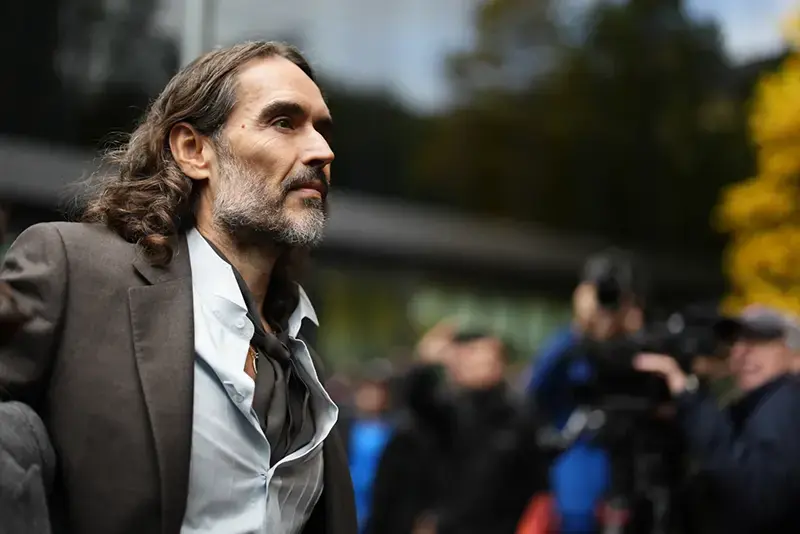
Russell Brand, the British actor-comedian, took the stand in his rape and sexual assault trial on Wednesday, denying all charges and claiming the allegations have had a ‘devastating’ impact on his life. The 51-year-old entered Southwark Crown Court alongside his wife, Laura Gallacher, as he testified in his own defense, stating that ‘today is the day for truth and justice.’
Testifying in His Own Defense
Brand, known for his risqué stand-up routines and battles with drugs and alcohol, rose to prominence in the early 2000s, hosting television programs and his own BBC radio show. He appeared in Hollywood films including ‘Forgetting Sarah Marshall’ and ‘Get Him to the Greek’ and was briefly married to pop star Katy Perry. In recent years, he has moved away from mainstream media, relocated to Florida, and built a large online following with videos mixing wellness, conspiracy theories, and discussions of his religious devotion.
During his testimony, Brand acknowledged that he had been obsessed with sex as a younger man but denied multiple charges of rape and sexual assault. He answered ‘no’ to each charge as his lawyer, Ian Winter, asked whether he was guilty of three counts of rape, three counts of sexual assault, and one count of attempted indecent assault. He stated that he had not forced any of the six alleged victims to do anything against their will.
Impact on Personal Life
Brand described the allegations as having had a ‘devastating’ impact on his life, with friends and colleagues abandoning him. He said that no one with relevant evidence had been willing to testify in court on his behalf. ‘My entire life has been consumed by these events, these allegations, these accusations,’ he said, adding that dealing with the ‘traumatic’ allegations had come ‘at the expense of my marriage, my children, and health.’
He also mentioned that he had been barred from staying with his baby son in hospital after anonymous allegations of sexual misconduct were made against him in a newspaper and a TV documentary in 2023. ‘The reason given by Great Ormond Street Hospital when my son was receiving open heart surgery and subsequent treatment was due to the material published,’ he said.
Prosecution’s Case
Over the past two weeks of the trial, prosecutors set out their case and the jury heard from six women who accuse Brand of sexual misconduct between 1999 and 2009. Prosecutor Riel Karmy-Jones told jurors that Brand was ‘ruthless, he was calculating, he was manipulative. And, the prosecution say, he was a sexual predator.’
The allegations cover a decade when Brand went from rising stand-up comedian to major celebrity in the U.K. The first victim alleges that Brand raped her in a hotel room during the Labour Party’s annual conference in the seaside town of Bournemouth in 1999. Another woman alleges that in 2001, Brand tried to drag her into the men’s bathroom at the London office of music channel MTV, where she worked.
A third woman alleges that Brand orally raped her in 2004 in the toilet of a London bar, and a fourth says Brand kissed and groped her at a London radio station in 2004 or 2005. Another complainant says Brand anally raped her at his home after she met him at one of his shows in 2009, while the sixth says the comedian demanded a massage and pressed his face into her groin during the recording of an advertisement in 2009.
Prosecutors say the women don’t know one another and separately went to police after the TV documentary was broadcast in 2023. The Associated Press doesn’t name victims of alleged sexual violence, and British law protects their identities from the media for life.
Cross-Examination and Denials
Under cross-examination by Karmy-Jones, Brand acknowledged he had dedicated a lot of his earlier life to ‘beyond reckless philandering.’ ‘As I became more successful and famous, I was very comfortable allowing that to facilitate sexual access, which I agree with you was wrong,’ he said.
He said ‘yes’ when asked if he had been obsessed with sex when he was younger, but ‘no’ when the prosecutor asked: ‘Do you accept that you were desperate for it and sometimes couldn’t function without it?’ As he completed a day on the stand, Brand was asked again whether he had committed the crimes he is accused of. ‘Not guilty is my plea in every single case,’ he said.
Background and Context
Russell Brand’s trial has drawn significant public attention, not only because of the gravity of the allegations but also due to his high-profile career. His rise to fame in the early 2000s included hosting television programs and his own BBC radio show, which helped him become a household name. His work in Hollywood films like ‘Forgetting Sarah Marshall’ and ‘Get Him to the Greek’ further solidified his status as a major celebrity in the U.K.
Despite his fame, Brand has faced a series of controversies over the years, including allegations of sexual misconduct that have resurfaced in recent years. The allegations against him span a decade, from 1999 to 2009, during which he transitioned from a rising stand-up comedian to a major celebrity. The case has also raised questions about the legal and media treatment of sexual misconduct allegations, particularly in high-profile cases involving public figures.
Public Reaction and Legal Implications
The trial has sparked a wide range of public reactions, with many expressing concern over the handling of such serious allegations. The legal implications of the case are significant, as it could set a precedent for how similar cases are handled in the future. The prosecution’s case relies heavily on the testimonies of the six women who have come forward, and the defense’s strategy has focused on challenging the credibility of these testimonies and the circumstances under which the allegations were made.
Brand’s defense has emphasized the importance of consent, stating that it is ‘fundamental, essential, necessary, and indeed in many ways more important than sex itself.’ This statement highlights the central issue of the case: the nature of the alleged misconduct and the role of consent in determining the validity of the charges.
Conclusion
Russell Brand’s trial continues to unfold, with the prosecution and defense presenting their arguments and evidence. The outcome of the trial will not only impact Brand’s personal and professional life but also have broader implications for how sexual misconduct allegations are addressed in the legal system. As the trial progresses, the public and legal community will be watching closely to see how the case is resolved and what it means for future cases involving similar allegations.
Source: OANN