Ghana Applies to Join BRICS Economic Bloc
Ghana seeks BRICS membership to challenge U.S. dollar dominance and boost economic ties.
3 min read
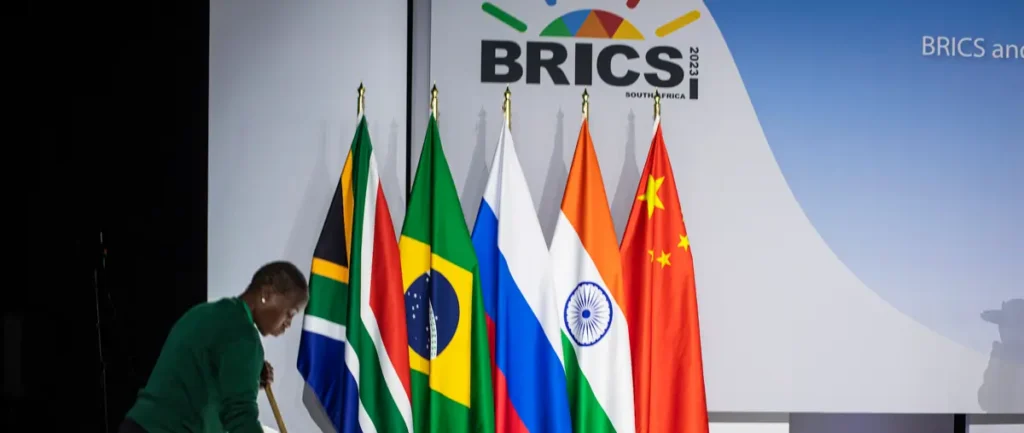
Ghana has become the fourth African nation to apply for membership in the BRICS economic bloc, a coalition formed to challenge the U.S. dollar’s global dominance and promote alternative economic routes. The country, rich in critical minerals, announced its intent to join the bloc during a joint press briefing with the visiting Indian External Affairs Minister S. Jaishankar.
Mineral Wealth and Strategic Importance
Ghana is a major producer of critical minerals, including gold, lithium, bauxite, manganese, and graphite. These resources are essential for the production of military equipment and advanced technologies. Manganese and bauxite are crucial for tanks, ships, and aircraft, while lithium is vital for batteries used in drones, missiles, and directed-energy weapons. Mining contributes over one-third of Ghana’s exports, with gold accounting for approximately 95% of the sector.
Government’s Strategic Move
“On the occasion of this important visit, I announced Cabinet’s strategic decision to apply for BRICS membership. The Government of Ghana is determined to position Ghana as a reliable friend to all as we expand our geopolitical and economic frontiers, anchored fundamentally on our national interest and freedom of choice in this fast-evolving multipolar world,” said Ghana’s Foreign Affairs Minister, Samuel Okudzeto Ablakwa, in a statement on X.
Ghana and India have advanced our bilateral relations during the working visit of External Affairs Minister, His Excellency Dr. S. Jaishankar. On the occasion of this important visit, I announced Cabinet’s strategic decision to apply for BRICS membership. The Government of Ghana is determined to position Ghana as a reliable friend of all as we expand our geopolitical and economic frontiers anchored fundamentally on our national interest and the freedom of choice in this fast evolving multipolar world. Ghana and India have committed to more railway projects after the successful Indian-financed Tema-Mpakadan railway construction. India is additionally set to increase investments in Ghana’s pharmaceutical sector as the Mahama Administration ramps up our local pharmaceutical production capacity under the President’s Accra Reset health sovereignty initiative. We are also deepening cooperation in digital technology and AI. I am equally glad that we have initiated negotiations on a Defence Cooperation Agreement to be completed early next year. During this impactful visit, we signed two significant agreements on scientific research collaboration and agricultural cooperation. Ghana is pleased to coordinate efforts next year as Chair of the African Union to develop an Africa-India strategy at next year’s Africa-India summit. Nehru and Nkrumah must be proud of the great gains we are making in our incredible Ghana-India Comprehensive Partnership under the visionary leadership of Mahama and Modi. For God and Country 🇬🇭 🙏🏾
Ablakwa made the announcement during a joint press briefing with the visiting Indian External Affairs Minister S. Jaishankar, highlighting the country’s commitment to aligning with BRICS’ guiding principles and contributing to the bloc’s growth. Ghana, a developing country, is the eighth-largest economy in Africa and represents West Africa in the African Union, where it plays a key role in regional security and development.
BRICS and Global Economic Shifts
BRICS is just one aspect of the growing competition between the United States and China on the African continent. While the U.S. has traditionally focused on humanitarian aid, China has invested heavily in infrastructure projects. As the U.S. dollar weakens, developing countries are increasingly looking beyond America for trade and economic partnerships, leading to the rise of blocs like BRICS.
A prospective member state must “align with the guiding principles of BRICS, contribute to the strengthening of BRICS, and be an emerging or developing country with regional and strategic global influence,” according to the BRICS Information Center. The coalition, which includes 11 members, represents 41% of global GDP, according to the BRICS-affiliated Institute for Digital Economy and Artificial Systems.
Source: Daily Caller