Trump Advocates Death Penalty for Firefighters’ Killers
President Trump calls for federal death penalty in cases of firefighter murders during White House event.
2 min read
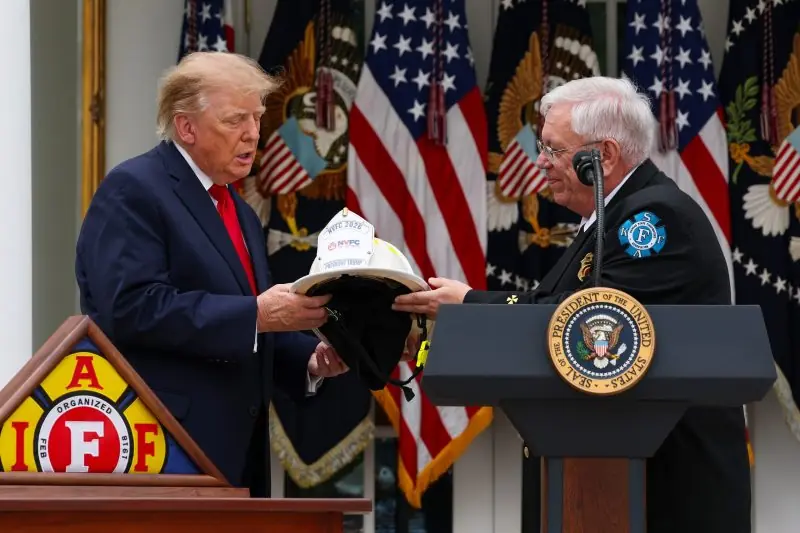
President Donald Trump announced during a White House luncheon for law enforcement and firefighters that he has directed the Department of Justice (DOJ) to seek the death penalty for anyone convicted of murdering a firefighter. The event, held at the Rose Garden, brought together representatives from major fire and police organizations, including the International Association of Fire Fighters and the National Sheriffs’ Association.
Expansion of Capital Punishment Policy
Trump’s directive builds on his prior advocacy for the death penalty in cases involving the killing of police officers. While the president emphasized a firm federal stance on violence against first responders, the practical implementation of such a policy remains limited. Federal capital charges typically apply only to specific federal offenses or crimes within federal jurisdiction, leaving state-level homicide prosecutions under individual state laws.
Remarks on Firefighters’ Risks
Speaking at the event, Trump highlighted the dangers faced by firefighters, stating, “They’re shot at [while] going up ladders. They get shot up in some neighborhoods…” His comments reflected a broader concern for the safety of first responders, who often face life-threatening situations during their duties.
Humorous Reference to Past Incident
During the luncheon, Trump humorously remarked on the firefighter helmet presented to him by Steve Hirsch, chairman of the National Volunteer Fire Council. He joked that he wished he had worn it during the July 2024 assassination attempt in Butler, Pennsylvania, where he was grazed by gunfire and former volunteer fire chief Corey Comperatore was tragically killed.
Support from Firefighters’ Organizations
The event received strong support from firefighter and law enforcement groups, many of whom expressed appreciation for Trump’s recognition of the dangers their members face. The presence of these organizations at the White House event underscored the significance of the president’s stance on protecting first responders.
Broader Implications
While Trump’s call for the death penalty represents a strong federal position, the actual enforcement of such a policy remains a complex legal and political issue. The distinction between federal and state jurisdictions means that the full impact of Trump’s directive may not be immediately felt across all states.
Source: OANN