ATF Ends Registration for Suppressors and Short-Barreled Rifles
ATF announces new policy eliminating registration for suppressors and short-barreled rifles, a major win for Second Amendment rights.
2 min read
Gun owners across the United States are celebrating a major victory for Second Amendment rights as the Bureau of Alcohol, Tobacco, Firearms and Explosives (ATF) has announced it will no longer require extended registration processes for suppressors and short-barreled rifles (SBRs). This decision marks a significant shift in federal firearms policy, aligning with recent legislative changes that have reshaped the landscape for legal firearm purchases.
A Major Shift in Federal Firearm Regulation
Previously, acquiring an SBR or a suppressor typically involved a $200 National Firearms Act (NFA) tax, an application to the ATF, a thorough background check, and a lengthy waiting period for approval. Even after approval, many gun owners opted to use gun trusts to register the items rather than register them individually. However, the passage of the One Big Beautiful Bill Act in 2025 changed this dynamic by reducing the NFA’s transfer tax to $0 for suppressors and SBRs.
In August 2025, a federal district court in Texas ruled that once Congress eliminated the tax, the 1934 NFA’s authority to require additional registration and transfer procedures could no longer be sustained. Initially, the injunction allowed the purchase of these devices without the extended ATF process but only applied to SilencerShop.com and the Gun-Owners of America, who were plaintiffs in the lawsuit.
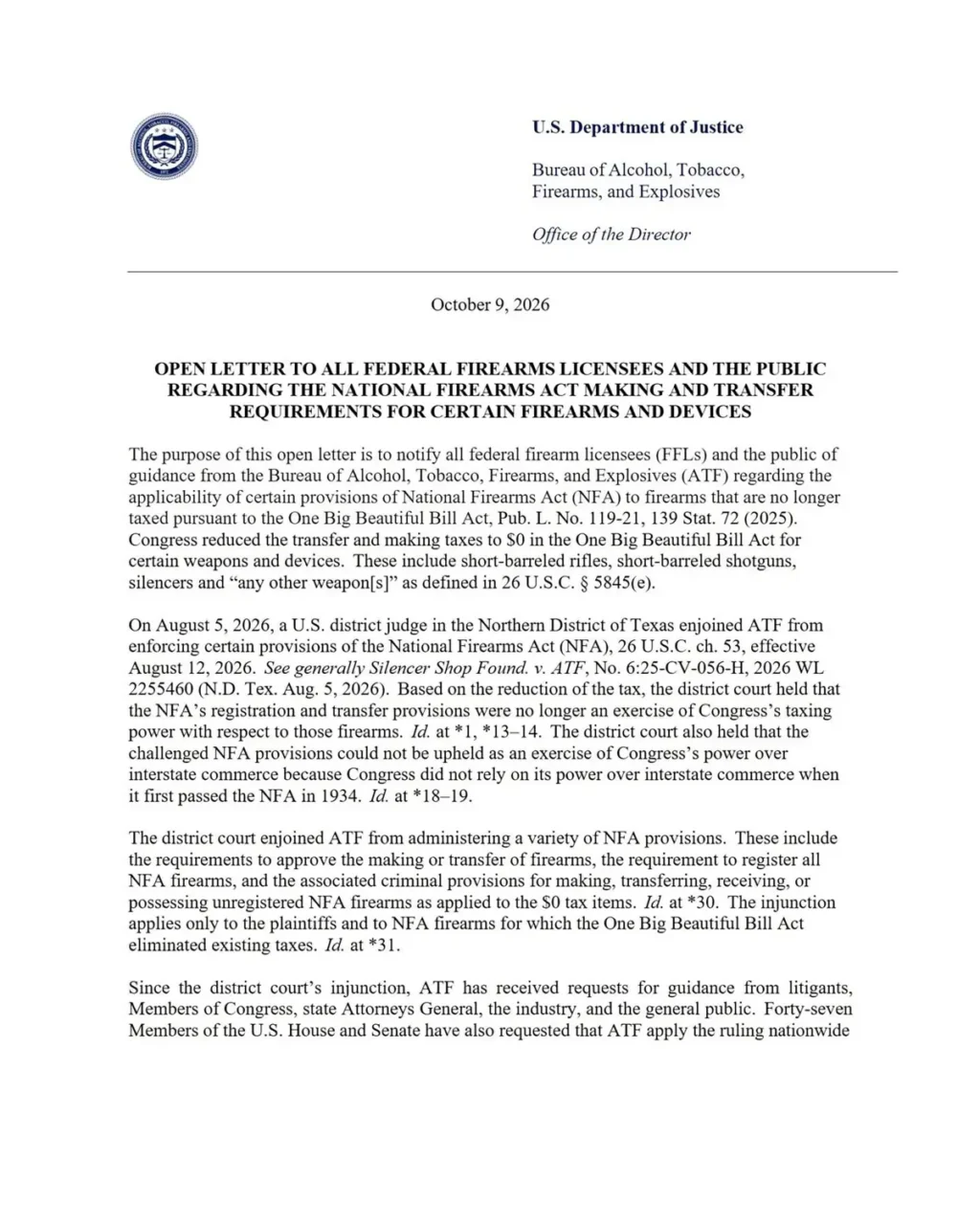
As of October 9th, 2026, the ATF issued an open letter to the public, stating that they will no longer require individuals to seek ATF approval under the NFA before making or transferring short-barreled rifles, short-barreled shotguns, silencers, and ‘any other weapon[s]’ as defined in 26 U.S.C. § 5845(e). These policies apply uniformly to anyone otherwise subject to these requirements, not just to the plaintiffs in the litigation.
🚨BREAKING: ATF has finally issued guidance following GOA’s historic NFA victory.
This decision is a landmark moment for gun rights advocates and legal firearm owners, signaling a more streamlined and accessible process for acquiring these items. The change reflects broader shifts in federal policy and highlights the growing influence of legislative action in shaping regulatory frameworks around firearms.
Source: The Gateway Pundit