Burma Junta Continues Airstrikes While Promoting Peace Talks
Burma’s military escalates civilian attacks while inviting rebels to peace talks, drawing global condemnation.
5 min read
Burma’s military junta has intensified its aerial campaign against civilian areas while simultaneously inviting ethnic armed groups to peace talks, a move that has drawn widespread condemnation from international observers and human rights organizations. The latest developments highlight a stark contradiction in the regime’s approach, as the military continues to bomb civilian targets, including markets and towns, while claiming to seek peace.
Peace Talks Amid Continued Violence
At an October event, Burma’s new defense minister, Lieutenant General Yar Pyae, claimed the air force’s bombing campaign serves peace. Yar Pyae, who also chairs the junta’s National Solidarity and Peacemaking Negotiation Committee, renewed the junta’s invitation to ethnic armed groups to join peace talks. The invitation was accompanied by a call for the People’s Defense Force (PDF), the armed wing of the opposition National Unity Government, to lay down its weapons.
The invitation followed an earlier peace initiative, which was accompanied by continued bloodshed. After Min Aung Hlaing took the title of president in April 2026, the junta announced a “100-Day Peace Initiative,” running from April 21 to July 31, and invited ethnic armed groups to Naypyitaw for talks. However, the UN Special Rapporteur’s latest report found that about 753 civilians were killed nationwide during that period, with the military and allied militias responsible for 89 percent of those deaths.
Escalating Aerial Attacks
Airstrikes allow the military to attack territory its ground troops cannot hold. In Rakhine, where the junta has lost 14 of 17 townships, the UN Human Rights Office found that the military relied primarily on air power to prevent the Arakan Army (AA) from advancing on Sittwe and Kyaukphyu. The AA has also overrun a major regional military headquarters since launching its offensive in November 2023, according to Agenzia Nova.
The UN Human Rights Office’s annual report to the Human Rights Council, covering June 2025 through May 2026, identified airstrikes as the leading cause of civilian deaths in Burma. Open sources recorded at least 2,592 air attacks during that period, a 17 percent increase over the previous year. Aerial attacks accounted for 845 of the 1,241 civilian deaths the office recorded.
Civilian Casualties and Humanitarian Crisis
The Assistance Association for Political Prisoners (AAPP), a Burmese rights monitor cited by the UN office, counted at least 8,075 civilians killed by the military between the February 2021 coup and May 31, 2026, including 1,074 children. The office said military restrictions prevented verification of thousands more deaths.
More recent monitoring showed the air campaign continuing to intensify. The Myanmar Internet Project, a digital-rights monitor, recorded 581 airstrikes from July through September, an increase of nearly 12 percent over the previous quarter. The strikes killed at least 353 civilians, including 34 children, and damaged civilian facilities, including three markets. Rakhine suffered more strikes than any other state or region.
The monitor found that nearly 97 percent of the strikes hit areas where internet service had been cut, hampering warnings and casualty reporting. The Armed Conflict Location and Event Data project (ACLED) linked the escalation to the military’s command reorganization in March. Since then, the air force has deployed groups of two to five fighter jets to strike individual targets repeatedly.
Targeting Civilian Infrastructure
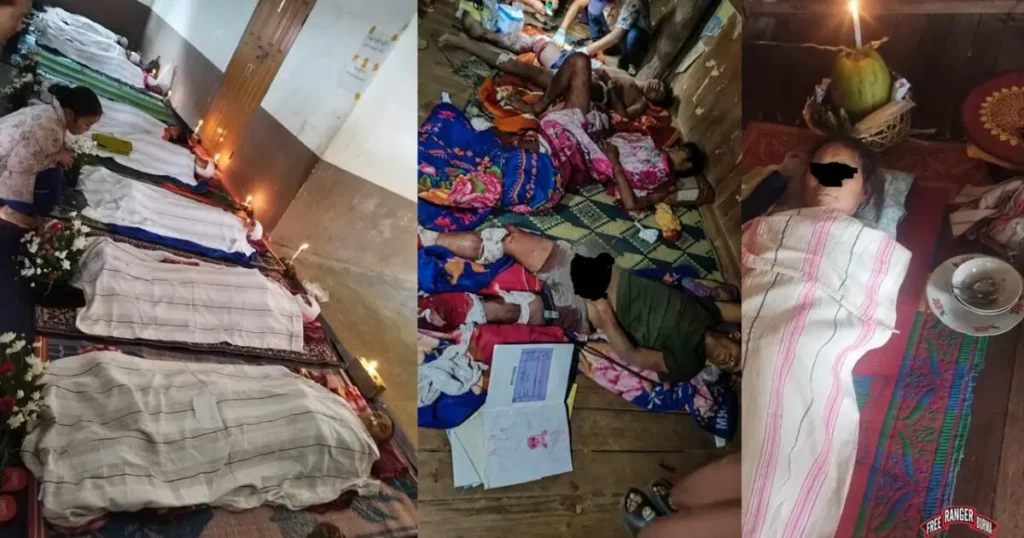
Markets in AA-held towns have been attacked repeatedly. On January 11, 2025, a junta aircraft made three passes over the market and town center of Kyauktaw, killing eight civilians and wounding 27, according to Burma News International. On February 24, 2026, a fighter jet bombed the Yoe Ngu market in Ponnagyun Township, killing 18 people. Most of the dead were women, and four were children between six and 15 years old. Residents told Myanmar Now that the AA had no forces in the area.
The September 28 attack struck near Kyauktaw’s India Market and Kissapanadi Bridge. The UN reported that the market’s more than 200 shops were crowded with traders, shoppers, and porters when the bombs hit at midday. Rescue official Wai Hun Aung described it as Rakhine’s largest wholesale market, serving buyers from across the state.
Political Pressure and Strategic Calculations
Rakhine politicians and analysts told Radio Free Asia that the junta increasingly uses attacks on civilians to pressure the AA into negotiations. Security analyst Sai Kyi Zin Soe said the military combines force with political and economic pressure, coordinated with neighboring countries, to seek a settlement on its terms. He added that mass-casualty strikes such as Kyauktaw may also aim to frighten residents into rejecting AA administration.
Thar Tun Hla, chairman of the Arakan National Party, said “the peace process requires trust” and that attacks on civilians make building that trust impossible.
Partial Engagement and Refusal to Negotiate
The Ta’ang National Liberation Army (TNLA), an AA ally, has held talks with the junta. On July 19, junta representatives met the group in Naypyitaw while the air force carried out strikes on five Rakhine townships over two days. The AA, the Kachin Independence Army, and the Karen National Union have refused to join the talks.
The AA said the Kyauktaw attack strengthened its determination to keep fighting. Spokesperson Khaing Thu Kha told RFA that the group would track down those responsible and take action against them.
International Condemnation and Calls for Action
Addressing the General Assembly on October 27, UN Special Rapporteur Kelley Anne Eckels-Currie said Min Aung Hlaing, despite his new title of president, was “still the same ruthless dictator using the same ruthless tactics.”
UN human rights chief Volker Türk has urged the Security Council to refer Burma to the International Criminal Court and called on governments to halt shipments of arms, jet fuel, and dual-use goods to the junta.
The UN’s Independent Investigative Mechanism for Myanmar (IIMM), which collects evidence for future prosecutions, reported in its annual report, published in August, a pattern of deliberate aerial attacks on homes, schools, medical facilities, religious buildings, and displacement camps. It said
Source: The Gateway Pundit