Colombian President Hands Over Drug Cartel Leader to U.S. Authorities
Colombia’s new president personally extradites a major narco-criminal to the U.S., signaling a shift toward stronger law enforcement cooperation.
5 min read
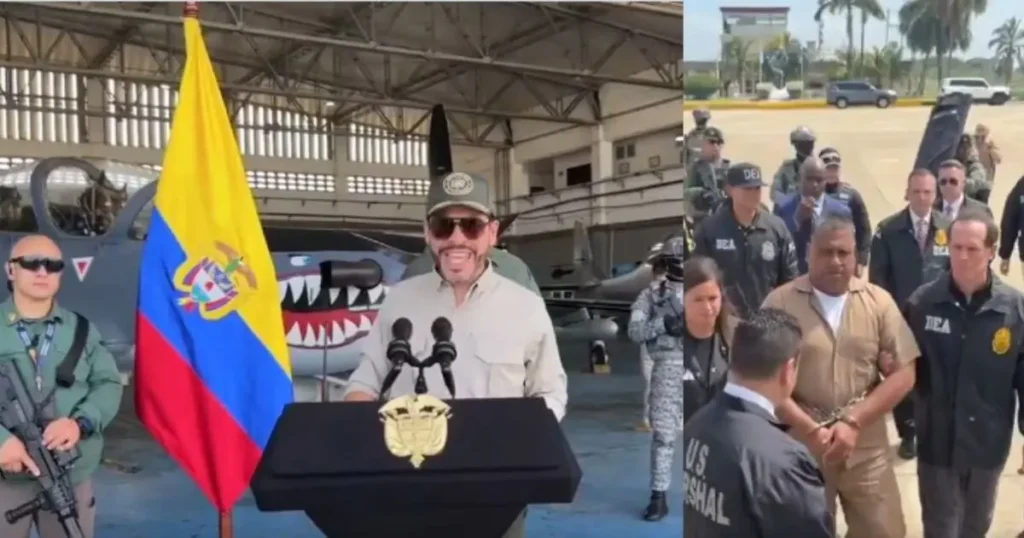
Colombia’s new right-wing president, Abelardo de la Espriella, has made headlines by personally overseeing the extradition of a major narco-criminal to the United States. The high-profile handover, which took place in a military hangar, marked a significant moment in the country’s ongoing efforts to combat drug trafficking and strengthen international cooperation.
Geovany Andrés Rojas, known by his alias “Araña” or “Spider,” was handed over to U.S. Marshals and DEA agents in a dramatic display of the Colombian government’s commitment to law and order. The event, captured on video and shared by the president on X, underscored the administration’s resolve to confront drug trafficking networks that have long plagued the region.
Rojas, 44, is accused of leading the Comandos de la Frontera, a faction of the National Coordinator of the Bolivarian Army, a FARC dissident network that rejected the 2016 peace deal. U.S. prosecutors have charged him with drug trafficking and criminal conspiracy, citing operations in Colombia and Ecuador dating back to 2017. The case was filed in the Southern District of California in early 2025, and Rojas landed in San Diego later that Friday under DEA and FBI escort.
“Today, the extradition of alias ‘Spider’ to the United States became effective,” de la Espriella stated in a video posted on X. “As President of the Republic, I personally oversaw the handover of Geovany Andrés Rojas, alias ‘Spider,’ leader of the Border Commands and wanted by the justice system of the United States.”
The president emphasized that the move was not just about apprehending a criminal but sending a strong message about the Colombian state’s determination to confront drug trafficking and strengthen its alliances. “This act represents far more than the handover of a criminal. It is an unequivocal message about the determination of the Colombian State to confront drug trafficking, strike at its structures, and strengthen cooperation with our allies to combat a criminal phenomenon that transcends our borders.”
Drug trafficking, the president noted, has financed violence, terrorism, and organizations that have sown pain in the country for decades. “That is why we are acting against the entire criminal chain: illicit crops, laboratories, routes, finances, and leaders who grow rich at the expense of the blood and peace of mind of our citizens.”
Colombia will no longer be a refuge for drug traffickers wanted by international justice. “Those who seek to use our territory to produce, transport, or commercialize cocaine will have to answer to the justice system and face the full, legitimate weight of the State,” the president added.
De la Espriella also reiterated his commitment to the people of Colombia, vowing to continue working to reclaim the country’s territory, protect families, and restore peace to regions affected by these criminal organizations. “To the criminals, I send an equally clear message: the State will pursue you, capture you, and, when warranted under the law, extradite you,” he said.
“Colombia’s security is not delegated. It is exercised with authority, determination, and within the bounds of the law,” the president concluded, ending with a rallying cry: “Firm for the Homeland! Long live Christ the King!”
The Supreme Court of Justice authorized Rojas’ extradition, and de la Espriella signed the order without delay. This marked the 94th extradition carried out during his administration, a significant number that highlights the government’s focus on international law enforcement cooperation.
Rojas was arrested in Bogotá in February 2025 on an Interpol red notice while participating in Gustavo Petro’s “total peace” talks. Colombia’s Supreme Court cleared his extradition in 2025, but former President Petro had suspended the handoff so Rojas could remain at the negotiation table as a key player. This decision was a strategic move to keep the peace talks on track, but it also delayed the legal process until de la Espriella took office.
Colombia’s attorney general has separately linked Rojas to killings in Caquetá, a region that has been a hotspot for drug-related violence. The connection between Rojas and these crimes further underscores the gravity of his alleged activities. Additionally, AP and Reuters reports indicate that Rojas was involved in running cocaine through Putumayo, a region on the borders of Ecuador and Peru, which has long been a key transit point for drug trafficking operations.
Rojas’ extradition also highlights the growing importance of international cooperation in the fight against drug trafficking. The U.S. and Colombia have a long-standing partnership in this area, and this handover represents a significant step forward in their collaborative efforts. The fact that the president personally oversaw the process signals a shift in policy, moving toward a more aggressive stance against organized crime.
As Rojas prepares for his first federal appearance before Magistrate Judge Steve B. Chu in the Southern District of California, the case will be closely watched by legal experts and law enforcement officials. The extradition process, while a major victory for the Colombian government, also raises questions about the balance between national sovereignty and international justice. How will this case affect future extraditions, and what does it mean for the broader fight against drug trafficking?
The move by de la Espriella is part of a broader trend in Colombia’s approach to security and law enforcement. With the country still grappling with the legacy of the drug war and the challenges of transitioning to a more peaceful society, the government is under pressure to demonstrate its commitment to dismantling criminal networks. This extradition is a clear signal that the administration is willing to take decisive action, even if it means challenging previous policies and taking a more hardline stance on crime.
As the case moves forward, the focus will remain on the legal proceedings, the potential consequences for Rojas, and the broader implications for Colombia’s relationship with the United States. For now, the handover stands as a powerful symbol of the country’s renewed commitment to law and order, and its willingness to work with international allies to combat the scourge of drug trafficking.
Source: The Gateway Pundit