Wall Street Funds Both U.S. and Chinese AI Rivalry
U.S. banks support American and Chinese AI growth despite national security concerns.
2 min read
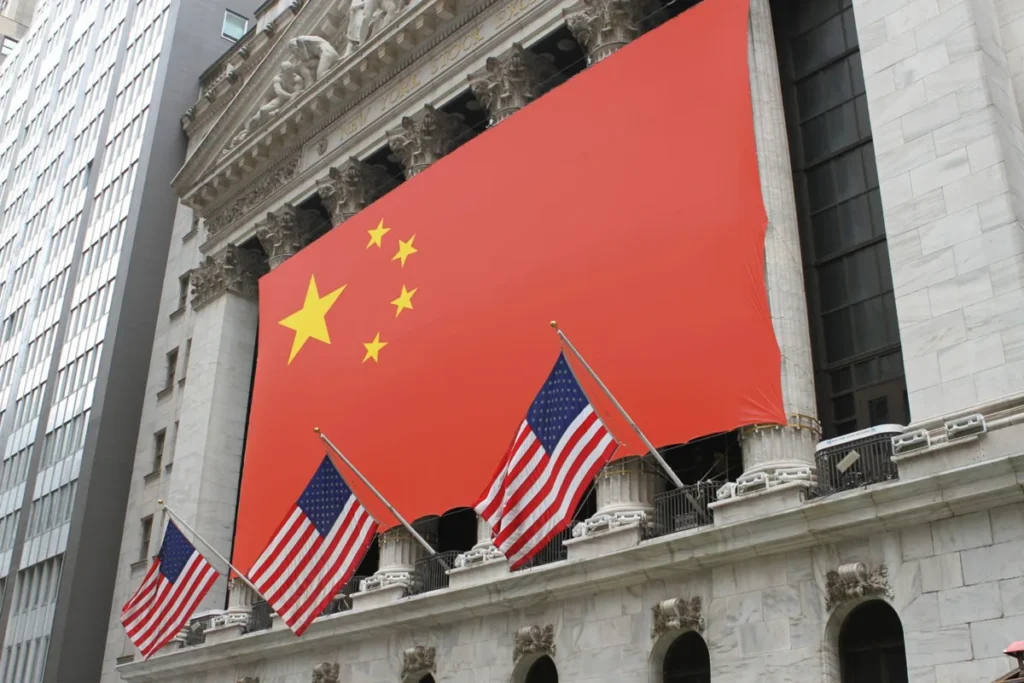
Wall Street’s largest banks are financing both the U.S. and Chinese artificial intelligence (AI) industries, despite growing U.S. efforts to restrict Chinese access to sensitive technology. Goldman Sachs, Morgan Stanley, Citigroup, and JPMorgan have participated in major Chinese AI, semiconductor, and technology offerings in 2026, even as Washington sought to limit China’s technological advancement.
Chinese Tech Deals Amid U.S. Restrictions
According to LSEG data reported by Reuters, Wall Street banks acted as bookrunners on 19 Chinese high-tech equity deals worth $17.2 billion this year, accounting for nearly 30% of the sector’s total issuance. Goldman Sachs, Morgan Stanley, and Citigroup were among the joint global coordinators for Zhongji Innolight’s $6.8 billion Hong Kong share offering, which came after the Department of Defense added the company to its list of Chinese military entities in June.
Zhongji, which produces optical transceivers used in AI data centers, reported that 61.7% of its first-quarter revenue came from the United States and that the Pentagon designation had not affected its operations or orders. Morgan Stanley and Goldman also worked on Hong Kong offerings for Chinese AI developer MiniMax and semiconductor companies Montage Technology and Shanghai Iluvatar CoreX Semiconductor.
U.S. AI Investment and Debt
JPMorgan played a direct role in another Chinese AI supply-chain financing, identified as a joint sponsor of Victory Giant Technology’s $2.6 billion Hong Kong share sale. Meanwhile, U.S. technology companies increasingly turned to bond markets, banks, and private lenders to fund AI infrastructure, with Goldman Sachs estimating nearly $500 billion of AI-related debt had been issued in 2026 as of August.
JPMorgan also estimated the five largest U.S. hyperscalers would spend roughly $697 billion on capital expenditures in 2026 as companies raced to expand computing capacity. The financial connections between the two countries have persisted even as Washington increasingly treats Chinese AI and semiconductor advances as a national security issue.
Treasury Regulations and Legal Scrutiny
The Treasury Department’s Outbound Investment Security Program targets U.S. investments in China, Hong Kong, and Macau in semiconductors, microelectronics, and AI, but does not prohibit all Wall Street activity involving Chinese companies in these industries. Treasury guidance states that underwriting services for an initial public offering by a covered Chinese company generally do not constitute a covered transaction unless the bank acquires a covered equity interest.
Wall Street’s work with strategically important Chinese companies previously attracted scrutiny from lawmakers, including the House Select Committee on the Chinese Communist Party, which subpoenaed JPMorgan CEO Jamie Dimon and Bank of America CEO Brian Moynihan over their banks’ involvement in the Hong Kong listing of CATL, a company the Pentagon had placed on its list of Chinese military entities.
Source: Daily Caller