Spacecraft Falls Back to Earth After Failed NASA Telescope Rescue
A spacecraft designed to rescue NASA’s aging telescope fell back to Earth after facing technical challenges.
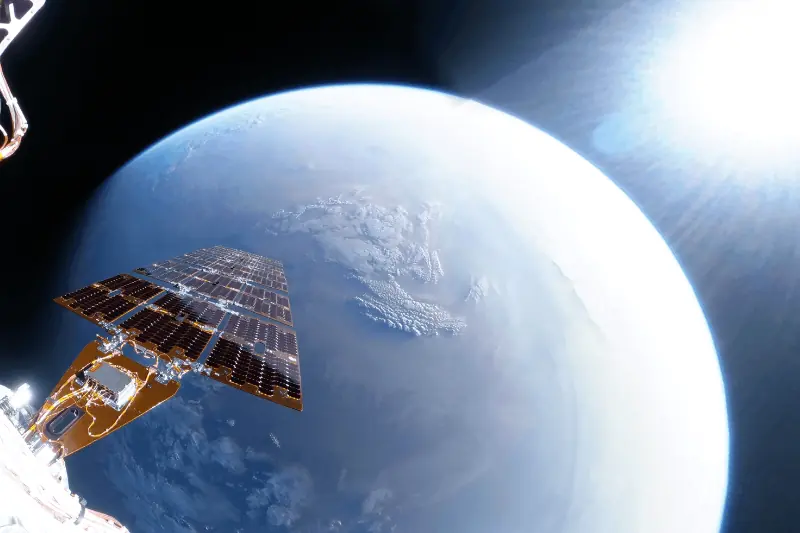
3 min read
A robotic spacecraft sent to rescue NASA’s aging Neil Gehrels Swift Observatory fell back to Earth less than three months after its launch, marking the end of a high-risk mission. Katalyst Space Technologies, the company behind the spacecraft known as LINK, announced the mission’s conclusion, noting that the spacecraft did not achieve its primary objective of capturing and boosting the telescope to a higher orbit.
Failed Rescue Mission
LINK, a three-armed robotic spacecraft, was intended to capture the Swift Observatory and raise its orbit, as the telescope was in a decaying low-Earth orbit and expected to reenter the atmosphere this year. Despite being launched with the goal of extending the telescope’s operational life, the mission faced significant technical hurdles.
According to Katalyst Space, the spacecraft encountered electronic problems that disabled two of its three reaction wheels, which are essential for maneuvering. Although engineers were able to regain control, the spacecraft did not have enough fuel to carry out its intended task, leading to the mission’s cancellation in August. The remaining weeks were used to practice maneuvering the spacecraft’s arms, each about three feet in length with hand-like grippers.
Technical and Operational Challenges
Despite the mission’s failure, Katalyst Space highlighted the valuable experience gained during the 85-day operation in orbit. The company stated that the mission demonstrated a new model for rapidly fielding and operating complex robotic spacecraft, which could inform future developments in the field.
“LINK was built to take on a problem that did not have an easy solution,” said Katalyst Space CEO Ghonhee Lee. “We knew from the beginning that this was an ambitious mission on an aggressive timeline. While we did not accomplish every objective we set out to achieve, in less than a year we went from mission concept to launching and operating the first commercial space robot. This is a foundation we can build on.”
Impact on NASA’s Mission
NASA acknowledged the mission’s challenges but expressed that the effort was still worthwhile. “Without intervention, Swift was going to re-enter the atmosphere by year’s end,” said NASA Astrophysics Division director Shawn Domagal-Goldman. “And while we’ll be sad to see Swift’s mission come to a close, we knew this boost effort would be worthwhile either way – advancing U.S. spacecraft servicing technology, challenging us to meet unprecedented mission timelines, and testing how we operate satellites to extend their time in low Earth orbit.”
NASA Administrator Jared Isaacman added, “This is not the outcome we were working toward, but it does not change why this mission was worth attempting. The team moved with extraordinary speed to give Swift a chance to carry out more science while advancing capabilities America will need for satellite servicing in the future.”
Although the spacecraft did not successfully capture the telescope, it managed to get about seven to nine miles from the observatory and captured some photos of it. The mission, while not achieving its primary goal, provided valuable data and experience that could benefit future space operations.
Source: OANN